
Yarosoft

Home / Our work

Case study · National tyre retailer

Nothing had gone wrong in years. That was the problem.

A national retailer had run for years without a serious IT failure, which is exactly why nobody had noticed there was no way back if one came.

Operations platform, simplified An agent on every Linux and Windows server pulls signed settings from the operations panel and never takes commands. Agents send encrypted backups off-site and report checks to the panel, which alerts staff by email and SMS. Operations panel Checks · jobs · roles Alerts by email and SMS pull signed settings, report results Linux servers Agent Web, data, legacy Windows Agent Core business system File exchange Agent Order flow Off-site storage · encrypted before it leaves each server
Simplified system diagram, drawn from the published project details. Not a screenshot.
Challenge
No backups running, a core business system on its own hardware, and rising attacks on businesses.
What we built
An operations platform with our own agent on every server, Linux and Windows.
Outcome
Every server watched and backed up; unapplied updates and pending restarts flagged to staff.
Scale
Every planned server, from web and data servers to the core business system and a legacy machine.
Status
Live
Challenge

The risk nobody could see

The business had its own IT staff, busy keeping everything running day to day. But no backups were running. The core business system sat on its own dedicated hardware, where one failed disk could take it down. And attacks on businesses were rising, with nothing in place to stop one.

One bad disk, or one ransomware email, and there was no way back.

"We've been fine for years"

It's the most natural objection there is, and the most dangerous. A long run without a failure doesn't mean the risk is low. It means the business hasn't been tested yet.
What we built

Not a backup script

A complete operations system, shaped around how this business actually runs: every server watched, every important system backed up off-site and encrypted, and alerts that go to the right person in plain words.

What it found straight away

As soon as it started watching, the system began flagging real issues to their staff: servers waiting on a restart, and security updates that hadn't been applied for years. Each one was caught and reported before it could cause harm.

Result

Now

The business can see how its systems are doing, every day, in one place. And it knows, because it has been tested, that it can recover.

The question isn't whether you've had a failure. It's whether you'd survive one.

Inside the system

What it looks like in use

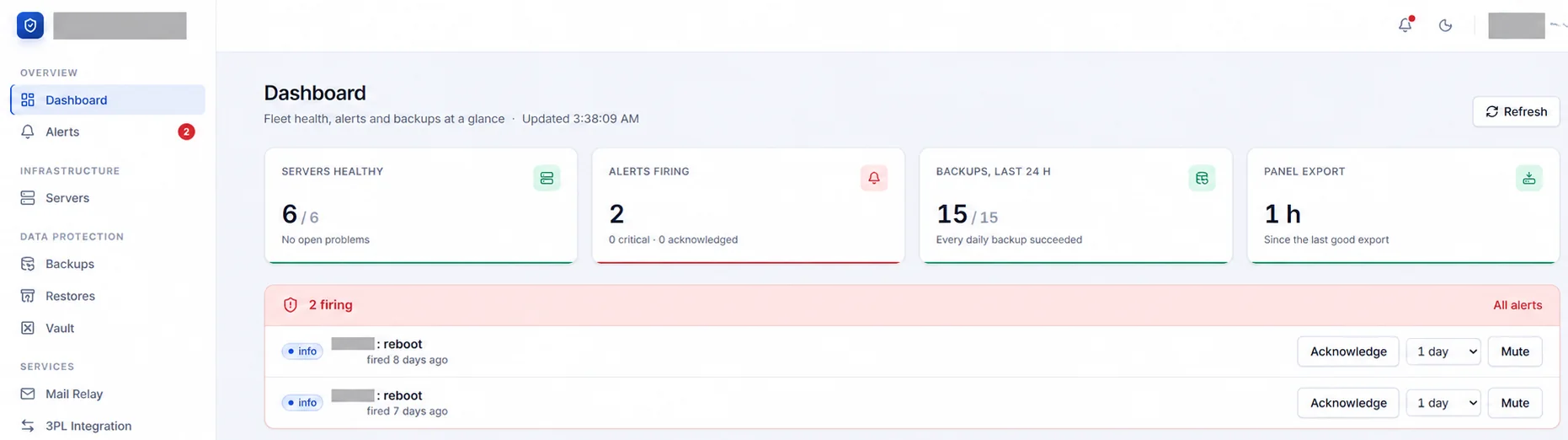
Operations dashboard showing six of six servers healthy, two info alerts for pending reboots, and fifteen of fifteen backups in the last day.
Fleet health at a glance. Server health, alerts and backups on one screen. Routine restart reminders show as alerts until someone deals with them.From the live system, with identifying details concealed. Select the image to see it full size.
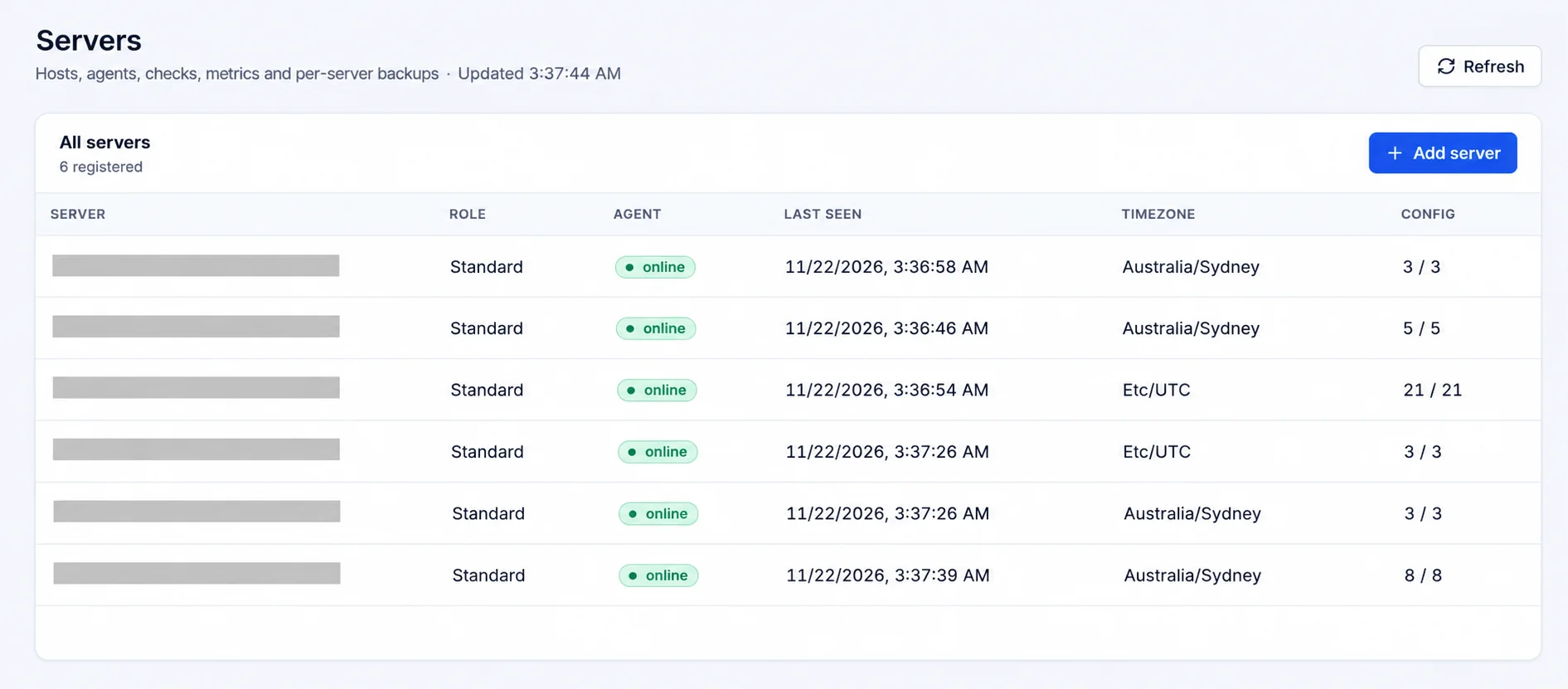
Server list with six servers online, last-seen times, timezones and configuration counts; server names concealed.
Every server, checked in. Each server's agent checks in regularly, showing its role, timezone and how many of its settings are applied.From the live system, with identifying details concealed. Select the image to see it full size.
Compared with the usual way

Off the shelf, or built for the business?

A typical approach: off-the-shelf backup software, a separate monitoring subscription, and updates applied when someone remembers.

AspectA typical approachWhat we built
Fit Generic checks and templates, the same for every customer. Checks chosen for each server's role, including the business's own order flow.
Backups Set up once and assumed to work. Encrypted before they leave each server, kept off-site, with restores tested and written up step by step.
Updates and restarts Noticed when something goes wrong. Pending security updates and restarts flagged to staff as soon as they appear.
Alerts A dashboard someone has to remember to check, or a flood of emails nobody reads. Short alerts by email and SMS, routed to the person who looks after that problem.
Remote access Vendor agents that often accept commands from the vendor's cloud. Agents that never take commands: they only pull signed, typed settings.
Software updates Pushed by the vendor on the vendor's schedule. Only releases signed by our key are installed, and a failed update rolls itself back.
Where the data lives In the vendor's cloud, on the vendor's terms. In storage the business controls, encrypted with keys the business holds.
Cost A subscription per tool, often priced per server or per device, that keeps rising. One system with no per-server licence fees, backing up to low-cost storage.
Technical detail

For your IT team: what we actually built

A self-hosted operations platform with an agent on every server, Linux and Windows, covering backups, monitoring, alerting and visibility into a third-party order flow.

  • Our own agent on every serverLinux and Windows, including a legacy Linux machine, each with a plan written for that server after a read-only survey.
  • Agents never take commandsThey connect out only and pull signed, typed configuration. The panel cannot run arbitrary code on a server.
  • Updates only with our signatureAgents update themselves when idle, verify the release signature against a key pinned at install, and roll back if the new version doesn't come up.
  • Encrypted, off-site backupsFiles and databases, encrypted before they leave the server, with restores tested, not assumed.
  • Monitoring shaped around the businessChecks chosen for each server's role, not a generic template: services, disks, updates, restarts, the order flow.
  • Alerts to the right peopleEmail and SMS, routed by what's wrong and who looks after it.
  • Roles and an audit trailStaff see what their role allows, and every sensitive action is recorded.
  • Documented for the people running itPlain-language guides inside the panel: restoring files and databases, rebuilding a server, restoring without the panel.

Tell us what's slowing you down.

Describe how things run today, or what worries you. We'll come back with a plain-English view: what we see, what we'd fix first, and roughly what it would involve. It's free, and yours to keep.

Get a free review