
Most business software can afford a slow moment or a retry. A trading system can't do the wrong thing twice, or once. Every order must be checked against risk rules first, every result must be reconciled with what the broker actually did, and a restart must pick up exactly where it left off.
Case study · Trading platform
Software where every decision is checked before it acts.
Few systems are less forgiving than one that places trades on its own. This story is about the engineering, not about trading results.
- Challenge
- Collect data, decide and act across several machines, without ever losing its place.
- What we built
- Data collectors, a compute fleet, a shared algorithm host, risk checks, execution and a client dashboard.
- Outcome
- Every order checked before it acts; restarts pick up exactly where they left off.
- Scope
- Several machines by role, broker connections and our own Windows MT5 bridge.
- Status
- Engineering only; no performance figures are published.
Challenge
Why it's hard
What we built
Several parts, working as one
Collectors that gather market and research data, a fleet of machines that trains and tests models, a shared host that runs each algorithm in isolation, a risk manager that checks every order, execution through broker connections, and a client dashboard with subscriptions and notifications.
New algorithms plug in as packages. Adding one needs no change to the platform itself.
Why it matters
Why it matters to you
Your business probably doesn't trade. But if your system needs to take in data, make decisions and act on them automatically, safely and without supervision, this is the standard we build it to.
Automation is only as good as the checks it runs before it acts.
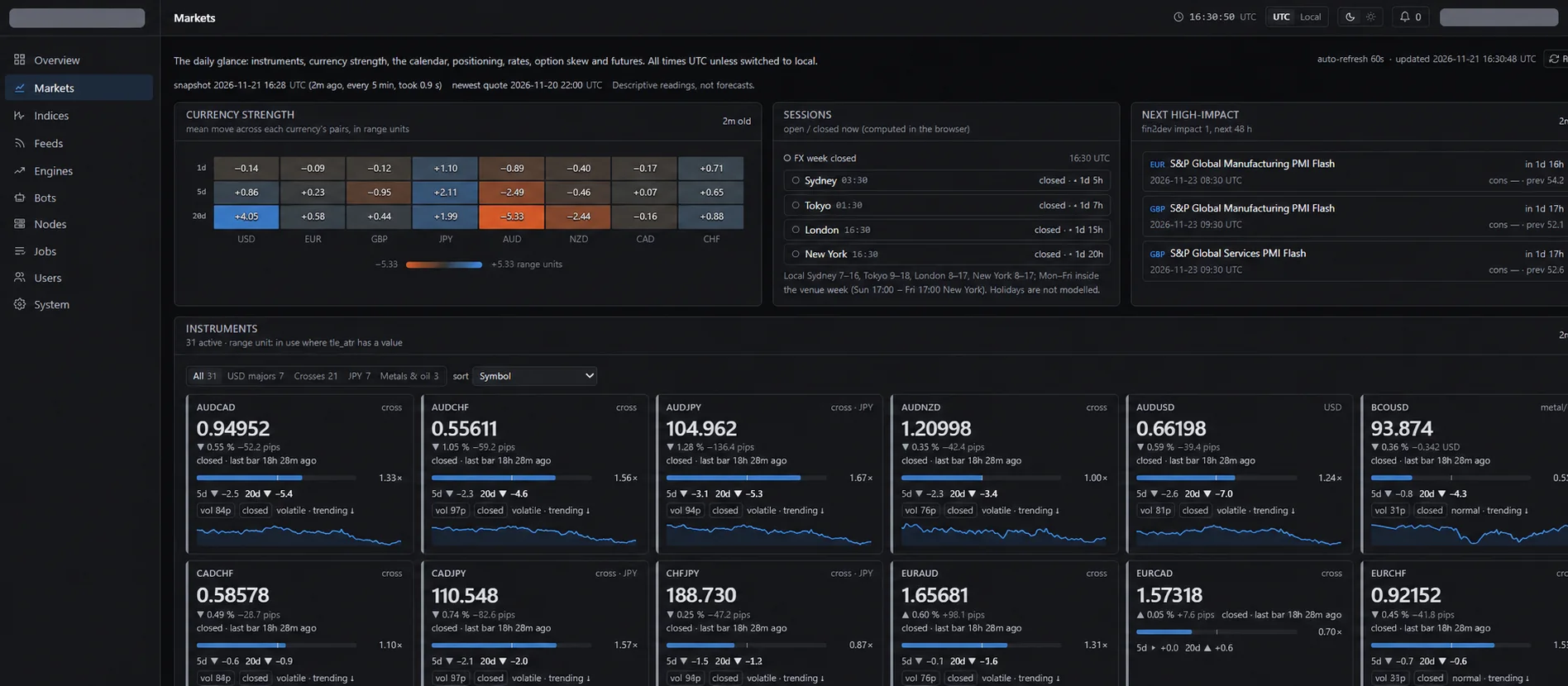
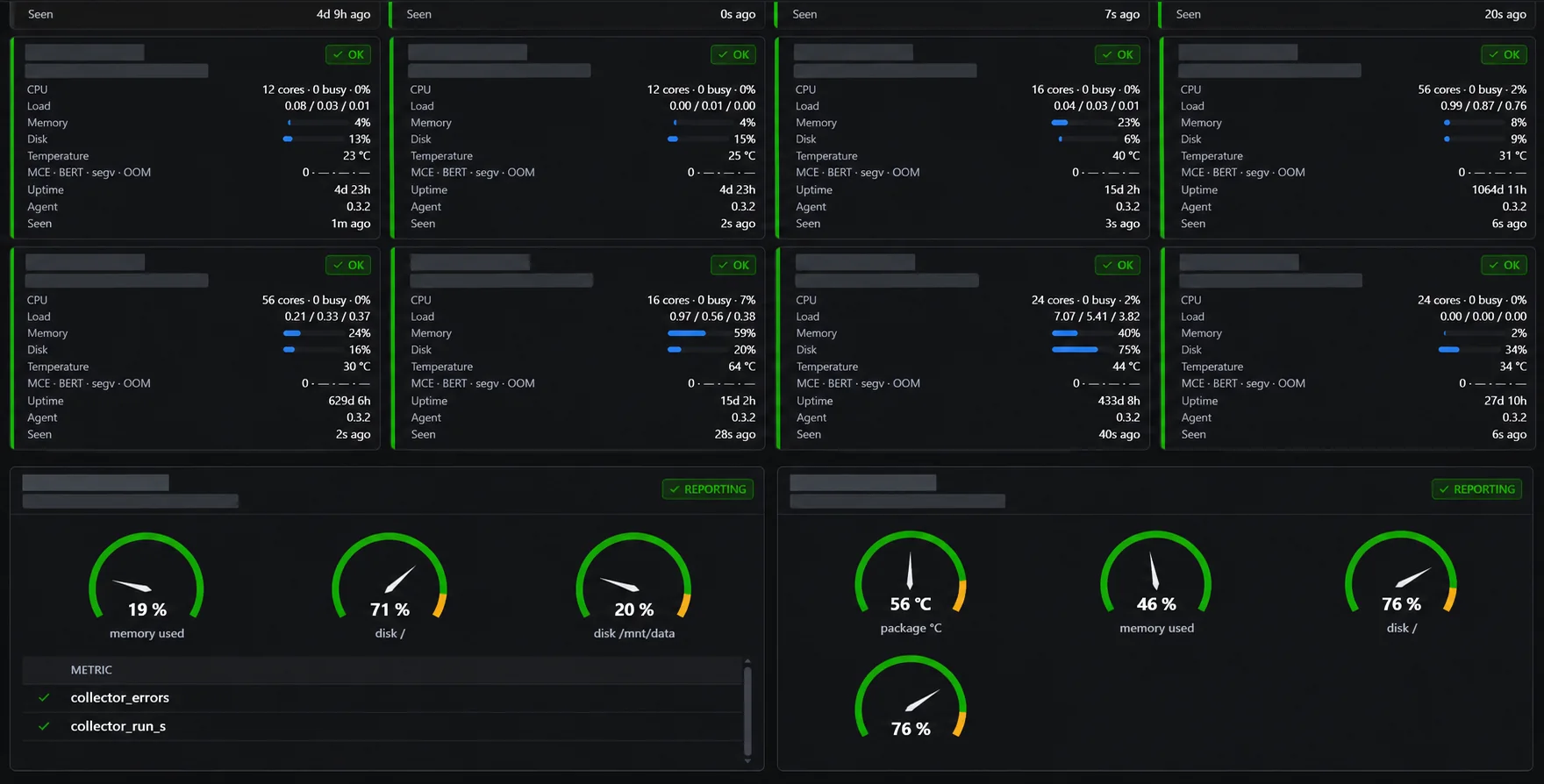
Inside the system
What it looks like in use
Compared with the usual way
Off the shelf, or built for the business?
A typical approach: an off-the-shelf trading bot or script on a single server, tested by hand on a desktop.
| Aspect | A typical approach | What we built |
|---|---|---|
| Structure | One program on one machine doing everything. | Separate roles across several machines: data, compute, execution and a client dashboard. |
| Risk | Settings per bot, checked by the bot itself. | Account-level risk and certification checks before every new position, outside the strategy. |
| Changing a strategy | Copy a new file over the old one while it runs. | Releases pinned to an exact fingerprint; running work finishes before a version changes. |
| A restart or crash | State lost, positions to be checked by hand. | Durable journals and reconciliation with the broker; it picks up exactly where it left off. |
| Research | Backtests run by hand on a desktop. | Training and replay spread across a fleet of machines. |
| Brokers | One platform, one connection. | Broker connections plus a Windows bridge we wrote for MetaTrader 5. |
| Clients | Manual reports and spreadsheets. | A dashboard with subscriptions, billing, notifications and live feeds. |
Technical detail
For your IT team: what we actually built
A multi-algorithm trading platform split by role across nodes (console, data and compute), a client-facing dashboard, and a Windows execution bridge for MetaTrader 5.
- Algorithms as plug-in packagesEach declares its own inputs, models, schedules, risk and certification. Publishing, enabling and assigning to bots are separate, deliberate steps.
- Releases bound to an exact hashContent-addressed releases, kept apart from datasets, models and live state. Activation is pinned to a hash, and running work drains before a version changes.
- A compute fleetTraining shards and replay jobs run across several machines, separately from the live host.
- Data collectorsMarket and research sources populated independently of any algorithm's schedule.
- Risk checked before every entryReadiness and certification checks, account-level risk and execution controls govern every new position.
- Protective management survives a switch-offA disabled algorithm stops new entries, but positions already open stay protected under the exact release that opened them.
- Execution across channelsA shared broker outbox with reconciliation, plus a Windows bridge we wrote for MetaTrader 5, with demo and live profiles, durable journals, automatic recovery and protected upgrades.
- Signed links between partsTrades published to the dashboard are authenticated per source with HMAC signatures; historical replays are labelled and kept apart from real fills.
- Client dashboardSubscriptions, billing, notifications and execution feeds for clients.
Tell us what's slowing you down.
Describe how things run today, or what worries you. We'll come back with a plain-English view: what we see, what we'd fix first, and roughly what it would involve. It's free, and yours to keep.